The Luminous Geometry of Ary Brizzi
To encounter the work of Ary Brizzi is to step into a realm where light, structure, and motion converge in a silent, rhythmic dance. Born in Buenos Aires in 1930, Brizzi emerged as a vital force within the Argentine avant-garde, a pioneer whose artistic language bridged the gap between the rigid precision of geometric abstraction and the hypnotic, sensory allure of Kinetic Op Art. His journey was one of constant metamorphosis; while his early training at the Escuela Nacional de Bellas de Bellas Artes Manuel Belgrano and the Escuela Superior de Bellas Artes Ernesto de la Cárcova initially focused on the tangible weight of the human figure, he soon found himself drawn toward the intangible—the way a line might vibrate or how a surface might capture the ephemeral essence of light.
As Brizzi’s vision evolved, he moved away from representation to embrace the profound possibilities of the Mad movement and the Asociación Arte Concreto-Invención. This transition marked his departure from the traditional canvas toward a more architectural and experimental approach to art. He became fascinated by the interplay of transparency and depth, often utilizing unconventional materials such as aluminum and Plexiglas to create works that seemed to breathe with their own internal luminosity. His first solo exhibition in 1958 at Gente de Arte served as a manifesto for this new direction, introducing a style that sought not just to depict space, but to actively manipulate the viewer's perception of it.
A Symphony of Tension and Light
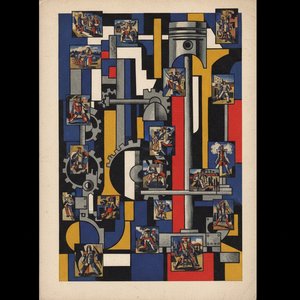
The true brilliance of Brizzi’s technique lies in his ability to instill life into static forms. In masterpieces such as Multiple tension 2, one observes a calculated exploration of rhythm and force. He mastered the art of using color as an emotional anchor; for instance, the deep, enveloping blues that suggest infinite intellectual depth are often set against assertive, intersecting red lines that pulse with vitality. These geometric vectors do not merely sit upon a surface; they create a visual symphony where horizontal and vertical planes collide to produce a kinetic effect, making the viewer feel as though the composition might shift or pulse under the weight of their own gaze.
This fascination with movement extended far beyond the gallery walls. Brizzi’s reputation as a visionary designer was solidified on the global stage through his groundbreaking work for the Argentine pavilion at the III World Trade Fair in New York in 1959. Here, he demonstrated that his principles of abstraction could transcend the frame, integrating seamlessly into architectural environments to redefine how humans interact with modern spaces. His work became a dialogue between the physical and the optical, utilizing the properties of light and shadow to stimulate the senses and challenge the boundaries of sight.
Legacy of an Argentine Visionary
Throughout his prolific career, Brizzi remained a central figure in the evolution of Latin American modern art. His contributions were not merely aesthetic but historical, as he helped steer the trajectory of Argentine abstraction toward a more sensory and interactive experience. The recognition of his impact was cemented in 1976 when he received the Great Honor Prize of the Salón Nacional in Buenos Aires, an accolade that honored his profound contribution to the nation's artistic heritage.
Today, the legacy of Ary Brizzi lives on through the enduring fascination with his ability to capture the "dynamic geometry of modern existence." His work remains a testament to the power of abstraction to evoke complex emotional resonances—ranging from the serene and contemplative to the energetic and urgent. He leaves behind a body of work that continues to inspire, reminding us that within the strict constraints of geometry, there exists an infinite capacity for movement, light, and soul.



 效果预览
效果预览
 切换至印刷版
 分享
分享 分享
分享
 详情
详情

 下载
下载
 相似作品
相似作品 X射线
X射线 幻灯片播放
幻灯片播放


 展开详情
展开详情






































 玻璃选项仅适用于110厘米以下的尺寸。