A Moment of Botanical Stillness: Georges Braque’s Flower Study
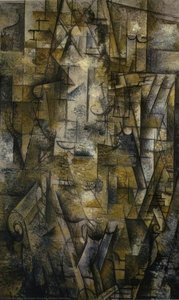
Georges Braque's "Flower Study," created in 1909, offers a captivating glimpse into the artist’s evolving approach to form and color during a pivotal moment in modern art. This deceptively simple black-and-white drawing—a piece often overlooked amidst his more celebrated Cubist works—reveals a quiet intensity and a profound engagement with the natural world. It's not merely a depiction of flowers; it’s an exploration of their essence, rendered through a masterful manipulation of line and shadow. The image presents a lily, its petals elegantly unfurling, positioned within a vase at the drawing’s upper left – a grounding element that anchors the composition. Scattered around are other blooms, some sharply defined, others softened by the artist's hand, creating an impression of depth and spatial ambiguity characteristic of Braque’s early explorations.
The Roots of Innovation: Braque’s Early Years and Artistic Influences
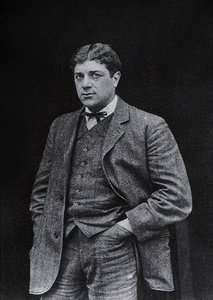
Born in Argenteuil, France, in 1882, Georges Braque's artistic journey began not with grand pronouncements of revolutionary style but with a deeply ingrained understanding of craft. His father was a house painter and decorator, providing him with an invaluable appreciation for materials, structure, and the subtle nuances of light and shadow – skills that would later inform his groundbreaking approach to Cubism. Initially following in his family’s trade, Braque's artistic spirit quickly asserted itself, leading him to formal training at the École des Beaux-Arts in Le Havre. This rigorous academic foundation, combined with his practical experience, proved crucial as he began to dismantle traditional notions of perspective and representation. His early years were marked by a close collaboration with Pablo Picasso, a relationship that profoundly shaped both artists’ development, particularly during their shared exploration of Cubism – a movement where the illusion of three-dimensionality was deliberately fractured.
Greige and Geometry: A Palette of Subtle Power
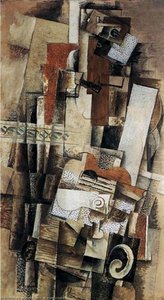
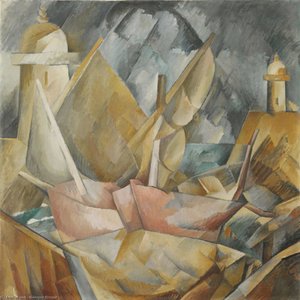
The monochromatic nature of "Flower Study" is key to its impact. Braque frequently employed what he termed “greige”—a sophisticated blend of gray and beige—as his primary palette during this period, a deliberate choice that prioritized form and structure over vibrant color. This restrained approach allowed him to focus on the underlying geometry of the flowers and their arrangement within the vase. Notice how the petals are broken down into fragmented planes, suggesting multiple viewpoints simultaneously – a hallmark of Cubist principles. The careful rendering of texture, achieved through subtle variations in line weight and shading, adds a remarkable sense of realism despite the absence of color. The drawing’s overall effect is one of quiet contemplation, inviting the viewer to consider the flower not as a single object but as a collection of intersecting shapes and planes.
Symbolism and Emotional Resonance: A Quiet Beauty
While often associated with radical abstraction, Braque’s early work retains a strong connection to the natural world. Flowers, in this context, represent beauty, fragility, and the cyclical nature of life – themes that resonated deeply within the artistic circles of Paris at the turn of the 20th century. The arrangement itself—the lily as a central focus, surrounded by other blooms—suggests an appreciation for harmony and balance. The drawing’s inherent stillness evokes a sense of peace and introspection, offering a moment of respite from the bustling energy of Parisian life. “Flower Study” is not simply a botanical illustration; it's a testament to Braque’s ability to capture the essence of beauty through careful observation and masterful technique – a quiet masterpiece that speaks volumes about the artist’s evolving vision.
Consider acquiring a high-quality reproduction of this evocative work. BuyPopArt offers meticulously crafted reproductions, ensuring you can bring the subtle nuances and profound beauty of Braque's "Flower Study" into your home or studio. Explore the artwork here.


 效果预览
效果预览
 购买手绘画作
 分享
分享 分享
分享
 详情
详情

 下载
下载
 相似作品
相似作品 X射线
X射线 幻灯片播放
幻灯片播放

 展开详情
展开详情






































 玻璃选项仅适用于110厘米以下的尺寸。