DrawingWallArtGeorgian
 1760Early Modern
 8.0 x 14.0 cm
 Leeds Museen - Galerien
Handgemaltes Ölgemälde auf Leinwand in Ihrer Wunschgröße und mit Rahmen, auf Bestellung von unseren Künstlern angefertigt. ( Druck bestellen Bild kaufen)
Wählen Sie aus unseren vordefinierten Formaten, die den ursprünglichen Proportionen des Kunstwerks entsprechen.

Sie können Ihre eigenen Maße eingeben, um einen bestimmten Rahmen oder Platz auszufüllen. Wenn die gewählte Größe nicht den Proportionen des Originalbildes entspricht, werden wir das Kunstwerk entweder beschneiden oder das Gemälde durch zusätzliche, handgemalte Elemente erweitern. Ein digitales Mockup wird Ihnen zur Genehmigung zugesandt, bevor die Produktion beginnt.
Bitte beachten Sie, dass die Bildschirmvorschau nicht die tatsächliche Beschneidung oder Erweiterung widerspiegelt. Nur das Mockup zeigt die endgültige Komposition exakt an.
Obwohl Sondermaße verfügbar sind, empfehlen wir, eine Größe aus der vordefinierten Liste zu wählen, um die ursprünglichen Proportionen beizubehalten.
Weltweiter Versand () in nur 3 bis 4 Wochen statt der üblichen 5 Wochen. (16 August). Keine Kompromisse bei der Qualität.


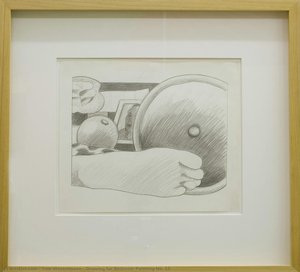
Drawing for a table
Format der Reproduktion
In the delicate lines of this 1760 drawing for a table, we find more than just a blueprint for furniture; we encounter a window into the refined soul of the Georgian era. Created by the legendary English cabinet-maker Thomas Chippendale, this exquisite work serves as a testament to an age where utility and artistry were inextricably linked. The drawing captures the essence of a pier or sideboard table, envisioned with a luxurious top of either polished marble or deep, rich mahogany. As the eye wanders across the composition, one perceives the meticulous planning of a master craftsman, whose hand was capable of translating grand architectural ambitions into the intimate scale of domestic splendor. The frame and legs, suggested to be finished in gold gilt or sophisticated paint, promise a piece that would not merely occupy a room but command it with an effortless, regal grace.
The technique employed here is one of precision and evocative suggestion. Through masterful use of line and subtle shading, Chippendale breathes life into the inanimate, creating a sense of depth and texture that invites the viewer to imagine the tactile reality of the finished object. The intricate carvings and ornamentation described in the composition reflect the Rococo influence that permeated the mid-18th century, characterized by flowing curves and organic motifs. This drawing is not merely a technical guide but an artistic performance, where every stroke contributes to a larger narrative of elegance. For the discerning collector or interior designer, this piece offers a profound study in how ornamentation can enhance structure without overwhelming it, providing a timeless blueprint for sophisticated spatial arrangement.
To understand this drawing is to understand the revolutionary impact of Thomas Chippendale himself. Operating from his workshop in St. Martin's Lane, London, Chippendale was a pioneer who bridged the gap between the artisan and the auteur. His seminal work, The Gentleman and Cabinet Maker’s Director, changed the landscape of British decorative arts forever, and this specific drawing for a table embodies the very spirit of that publication. It represents a moment in history when the rising middle class and the aristocracy alike sought to express their status through the curated beauty of their surroundings. The presence of decorative vases and secondary furniture in the background of the illustration suggests a complete vision of an 18th-century interior—a curated stage for social ritual and refined conversation.
For those seeking to bring a touch of historical majesty into a contemporary setting, a high-quality reproduction of this work serves as a powerful focal point. It carries with it the emotional weight of history, evoking a sense of nostalgia for an era of unparalleled craftsmanship. Whether placed in a study, a grand hallway, or a curated gallery space, this piece inspires a deep appreciation for the intersection of fine art and functional design. It is an invitation to contemplate the enduring power of beauty and the way a single, well-conceived design can transcend centuries to continue captivating the modern imagination.

Thomas Chippendale (5. Juni 1718 – 13. November 1779) war ein englischer Schrankmacher und Möbeldesigner, der die Welt des Innenbaus während der Georgianischen Ära revolutionierte. Seine innovativen Designs und seine außergewöhnliche Handwerkskunst festigten seinen Platz als eine der einflussreichsten Figuren in den britischen Dekorationskünsten.
Geboren in Otley, Yorkshire, England, bleibt Chippendales frühes Leben bis zu einem gewissen Grad rätselhaft. Er begann seine Karriere als Geselle Schrankmacher und verfeinerte seine Fähigkeiten in traditionellen Holzbearbeitungstechniken. Bis 1754 hatte er sein eigenes Werkstatt in St. Martin's Lane, London, gegründet und gewann schnell einen Ruf für Qualität und Originalität.
Chippendales bedeutendste Beitrag zum Bereich war zweifellos The Gentleman and Cabinet Maker’s Director, das 1754 veröffentlicht wurde. Dieses Musterbuch, bestehend aus über 160 angebrannten Tafeln, zeigte eine vielfältige Reihe von Möbeldesigns – von eleganten Rokoko-Stücken bis hin zu stärker zurückgehenden Neoklassischen Formen. Es war ein sofortiger Erfolg und diente als wichtige Ressource für Schrankmacher in England, Europa und Amerika.
Chippendales Stil wurde nicht isoliert entwickelt; er war eine Synthese verschiedener Einflüsse:
Während viele ursprüngliche Stücke, die dem Werkstatt von Chippendale zugeschrieben werden, nur schwer zweifelsfrei identifiziert werden können, haben sich einige bemerkenswerte Beispiele erhalten:
Chippendales Einfluss auf das Möbeldesign ist unermesslich. Er hat nicht nur schöne Objekte geschaffen, sondern auch einen einzigartigen Stil etabliert, der die Georgianische Ära definierte. Seine Designs inspirieren weiterhin zeitgenössische Möbeldesigner und Produzenten.
Thomas Chippendale’s Vermächtnis reicht weit über das 18. Jahrhundert hinaus und festigt seine Position als echter Meister des Designs und eine zentrale Figur in der Geschichte der Dekorationskunst.

1718 - 1779 , Vereinigtes Königreich

Entdecken Sie das satirische Werk von Thomas Rowlandson! Erfahren Sie mehr über seine Kunst, den gesellschaftlichen Kontext des georgianischen Englands und seinen Einfluss auf die Kunstgeschichte. Expertenanalyse & Hintergrundinformationen.

Explore the life & art of Thomas Sandby (1721-1798), a pioneering English watercolourist and architect. Discover his innovations, role in founding the Royal Academy, and lasting legacy at BuyPopArt.

Explore the life & work of Thomas Barker of Bath, a key figure in 19th-century English Romanticism. Discover his Parisian success, iconic paintings like 'The Bride of Death', and lasting artistic legacy. Learn more at BuyPopArt.

Entdecken Sie die harmonische Verbindung von Kunst, Möbeln & Materialien! Expertenratgeber für ein stilvolles Zuhause mit emotionaler Tiefe. Jetzt lesen & inspirieren lassen!

Explore the life & work of Thomas Hudson, a leading 18th-century British portraitist. Discover his mastery of the 'Grand Manner,' influential style, and lasting impact on British art. Learn about his notable portraits like Judge William Noel & Alexander Van Aken.


Bleiben Sie über die neuesten Kunstnachrichten, exklusive Angebote und Dekorationsideen auf dem Laufenden.
Erzählen Sie uns von Ihrem Projekt, und unsere Kunstexperten erstellen für Sie drei personalisierte Kunstvorschläge.
Wir kuratieren 3 Optionen exklusiv für Sie – kostenlos!


 Vorschau anzeigen
 Versenden
 Teilen
 Details anzeigen

 Herunterladen
 Ähnliche Objekte
 Röntgenaufnahme
 Diashow
 Weiterlesen




































 Die Glasoption ist nur für Größen unter 110 cm verfügbar.