
 GoldBaroque Mannerism
 1540Renaissance
 26.0 x 33.0 cm
 Kunsthistorisches Museum
Museum-quality giclée or canvas print with fast production and flexible finish options. ( Buy Hand Made Painting Buy Image)
Pick from our preset sizes that match the artwork's original proportions.

You may enter your own dimensions to fit a specific frame or space. If your selected size does not match the original image's proportions, we will either crop the artwork or extend the image with a mirrored or solid-fill edge. A digital mockup will be sent for your approval before production begins.
Please note that the on-screen preview does not reflect the actual cropping or extension. Only the mockup will accurately show the final composition.
While custom sizes are available, we recommend selecting a dimension from the predefined list to preserve the original proportions.
Worldwide Delivery () in 2 weeks instead of standard 4/5 weeks. (15 August)


Salt Cellar
Reproduction Size
The Saliera, of rolled gold, was created by Benvenuto Cellini for Francis I of France between 1540 and 1543. From his descendant Charles IX it passed to Archduke Ferdinand II. The saltcellar shows an allegory of the Earth and the interplay of land and sea. Its right side has a man with a trident and a ship symbolizing water, while its left side has a woman representing the Earth. The base depicts the winds, the times of day and human activities.
Cellini’s overall technique in designing the salt cellar for King Francis I stemmed from methods that he learned from Caradosso (Cristoforo Foppa). He noticed that Caradosso would “make a little model in wax of the size he wished his work to be.” Eager to make an art piece more grand and dissimilar than Caradosso’s, Cellini utilized the idea of making a wax model. The end product was based on a model that Cellini had originally created for Ippolito d’Este.
Cellini tells us that when Cardinal Ippolito d’Este–a rabid art collector now mostly remembered for looting Emperor Hadrian’s Villa–approached him about the work, the commission included the theme for its design, but Cellini makes it clear that all the credit really belongs only to him. “The Cardinal, who was a very kindly listener, showed extreme satisfaction with the designs which these two able men of letters had described in words,” he writes. “Then I turned to the two scholars and said: *You have spoken, I will do*.”
Notably, he doesn’t name the main figures—they would only later be identified as Neptune and Tellus. As Charles Hope explains in his book Patronage in the Renaissance, Cellini was primarily interested in the composition, and the appropriate subject matter came later.
Cellini’s Saliera is a masterpiece of Mannerist sculpture—a style characterized by dramatic flair and stylistic complexity. The sculptor showcased the multifaceted meanings of small objects of the era. Famously stolen in 2003, the saltcellar was recovered in 2006 and the thief was imprisoned.
The Saliera stands as a testament to Cellini's genius—a singular achievement that continues to inspire awe and admiration. Its intricate design and masterful execution exemplify the pinnacle of Renaissance goldsmithery.
Benvenuto Cellini was a remarkable figure of the Italian Renaissance, renowned as an accomplished goldsmith, sculptor, draftsman, soldier, musician, and writer. His multifaceted talents and flamboyant personality are vividly captured in his celebrated autobiography, considered a significant literary work alongside his artistic achievements. He embodies the spirit of Mannerism, a period following the High Renaissance characterized by dramatic flair and stylistic complexity.
Born into a family with musical inclinations – his father was a musician and instrument maker – Cellini initially showed promise in music. However, at fifteen, he passionately pursued a career as a goldsmith, convincing his reluctant father to apprentice him to Antonio di Sandro (known as Marcone). This marked the beginning of his formal artistic training. His early years were not without incident; at sixteen, he became embroiled in an affray with companions, leading to banishment from Florence and a period working in Siena under goldsmith Fracastoro.
Cellini’s style is characterized by its dynamism, realism, and attention to detail. He drew inspiration from classical antiquity and Michelangelo's powerful figures, but infused his work with a distinctly Mannerist sensibility – elongated forms, exaggerated poses, and a sense of theatricality.
Cellini’s life extended far beyond the workshop. He served as a soldier during sieges, claiming to have played a crucial role in defending Rome against imperial forces. He was also an accomplished musician, playing the cornett and flute at papal court. However, it is his autobiography that truly sets him apart.
His autobiography is not merely a recounting of events; it's a carefully constructed self-portrait designed to showcase his talents and justify his actions. While sometimes unreliable due to Cellini’s own biases, it remains an essential primary source for understanding Renaissance life.
Benvenuto Cellini died in Florence in 1571, leaving behind a legacy as one of the most important artists of Mannerism. His technical skill, artistic innovation, and captivating autobiography continue to inspire artists and art enthusiasts alike. He represents the quintessential Renaissance ideal – a polymath skilled in multiple disciplines, driven by ambition, and unafraid to express his individuality. His works are celebrated for their beauty, craftsmanship, and dramatic power, solidifying his place as a pivotal figure in Western art history.

1500 - 1571 , Italy
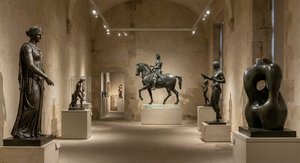
Journey through art history with our Top 10 bronze sculptures! Explore masterpieces by Rodin, Michelangelo & more. Discover stories behind iconic statues and find museum-quality reproductions for your home decor at BuyPopArt.com.

Discover how to elevate your home with the timeless elegance of metallic gold artworks. From sculptural metal pieces to gilded oil paintings, learn expert interior design tips for integrating luxurious gold accents into your space with sophistication and grace.

Journey through art history with 10 legendary bronze sculptures – from Michelangelo's David to Rodin’s Thinker. Explore the stories, techniques & timeless beauty of these masterpieces. Find museum-quality reproductions & elevate your home decor on BuyPopArt.com.

Explore the rich history of sculpture from ancient masterpieces to contemporary innovations. Discover key techniques, influential artists & investment potential for discerning art collectors.

Explore the life & art of Benvenuto Cellini, Renaissance goldsmith & sculptor. Discover his iconic 'Perseus,' masterful techniques, and enduring legacy – a collector's essential guide.


Stay updated with the latest art news, exclusive offers, and decoration ideas.
Tell us about your project and our art experts will provide you with 3 personalized art suggestions.
Let Us Curate 3 Options Just for You - Free!


 Send
Send Share
Share
 Details

 Download
 Similars
 Diaporama
 Read More




































 Glass option is only available in size under 110 CM


