Museum-quality giclée or canvas print with fast production and flexible finish options. ( Buy Hand Made Painting Buy Image)





























Pick from our preset sizes that match the artwork's original proportions.

You may enter your own dimensions to fit a specific frame or space. If your selected size does not match the original image's proportions, we will either crop the artwork or extend the image with a mirrored or solid-fill edge. A digital mockup will be sent for your approval before production begins.
Please note that the on-screen preview does not reflect the actual cropping or extension. Only the mockup will accurately show the final composition.
While custom sizes are available, we recommend selecting a dimension from the predefined list to preserve the original proportions.
Worldwide Delivery () in 2 weeks instead of standard 4/5 weeks. (19 August)


untitled (202)
Reproduction Size
Edward Hopper, a name inextricably linked to the quietude and subtle melancholy that permeated 20th-century American life, wasn’t simply a painter of scenes; he was a poet of light and shadow, a chronicler of modern isolation. Born in Nyack, New York, in 1882, to middle-class parents of Dutch ancestry, Hopper's early years provided a stable upbringing that nurtured his artistic inclinations. From childhood sketches meticulously dated and signed, it became evident that keen observation and an innate talent for drawing were central to his being.
Though initially encouraged towards commercial illustration – a pragmatic suggestion from his parents – Hopper’s ambitions leaned toward fine art, leading him to the New York School of Art where he studied under William Merritt Chase and Robert Henri. These formative years instilled not only technical skill but also an appreciation for realism and a commitment to depicting the world as he saw it. He sought to capture the essence of everyday life—the loneliness, the unspoken anxieties—with unflinching honesty.
Hopper’s oeuvre is characterized by its meticulous realism, achieved through smooth brushstrokes and careful attention to detail. He employed oil paints on canvas—a practice consistent with the artistic conventions of his time—to render scenes bathed in diffused light that heighten emotional resonance. The artist's technique prioritized clarity and precision, creating a sense of detachment rather than overt sentimentality.
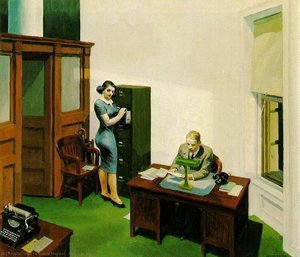
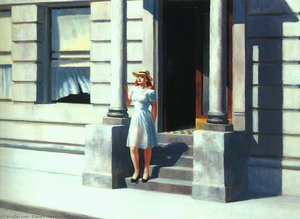
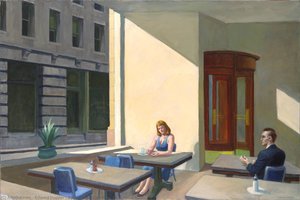
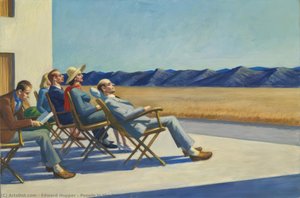
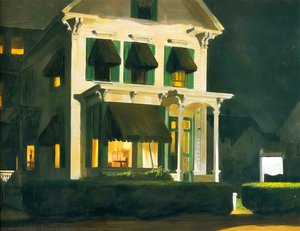
Perhaps no painting embodies Hopper’s signature aesthetic more powerfully than “untitled (202).” This artwork depicts a solitary figure seated on a bed within a sparsely furnished room—a motif recurrent throughout his career. The composition is dominated by strong geometric shapes – the rectangular window, the bed, and the walls – creating a feeling of confinement that speaks to the anxieties inherent in modern urban existence.
The muted color palette—primarily cool blues, grays, and pale pinks—underscores the melancholic mood. A warm pink hue highlights the figure’s garment, providing subtle visual contrast against the cooler tones of the room. Hopper's masterful use of perspective subtly suggests depth while maintaining a flattened surface, reinforcing the sense of detachment characteristic of his style.
“untitled (202)” resonates deeply with viewers because it captures a universal experience: the quiet contemplation of solitude amidst the bustle of daily life. It’s a poignant reminder of human vulnerability and longing—themes that Hopper explored consistently throughout his prolific artistic output, cementing his place as one of America's most enduring visual artists.

1931 - 1967 , United States of America

Explore the profound depth of American Realism. From the gritty Ashcan School to poignant social landscapes, discover how masters captured the raw soul of a nation through evocative oil paintings and timeless art history.


Stay updated with the latest art news, exclusive offers, and decoration ideas.
Tell us about your project and our art experts will provide you with 3 personalized art suggestions.
Let Us Curate 3 Options Just for You - Free!


 Preview
 Send
Send Share
Share
 Details

 Download
 Similars
 X-Ray
X-Ray Diaporama
 Read More







 Glass option is only available in size under 110 CM