x


Hand-painted oil on canvas in your size and frame, made to order by our artists.





























Pick from our preset sizes that match the artwork's original proportions.

You may enter your own dimensions to fit a specific frame or space. If your selected size does not match the original image's proportions, we will either crop the artwork or extend the painting with additional hand-painted elements. A digital mockup will be sent for your approval before production begins.
Please note that the on-screen preview does not reflect the actual cropping or extension. Only the mockup will accurately show the final composition.
While custom sizes are available, we recommend selecting a dimension from the predefined list to preserve the original proportions.
Worldwide Delivery () in 3/4 weeks instead of standard 5 weeks. (16 July). No compromise on quality.


Mont Sainte-Victoire (Metropolitan)
Reproduction Size
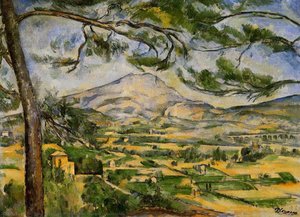
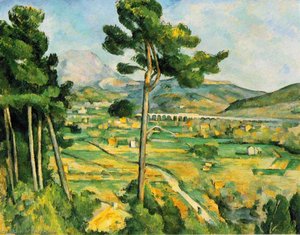
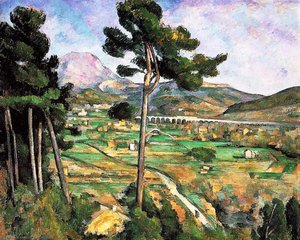
Behold a captivating vision of rural Provence in Paul Cézanne’s Mont Sainte-Victoire (painted between 1882-1885), a pivotal work bridging Impressionism and Post-Impressionism. This isn't merely a landscape; it's an intimate exploration of form, color, and the enduring spirit of nature – a scene Cézanne returned to repeatedly throughout his career.
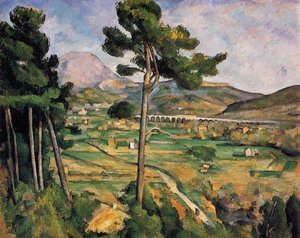
The painting centers on Mont Sainte-Victoire, the majestic mountain that loomed large in Cézanne’s life and artistic vision. He viewed it from his home in Aix-en-Provence, finding within its solid form a symbol of permanence and stability. The composition skillfully balances the imposing presence of the mountain with the rolling hills, verdant fields, and the architectural inclusion of the viaduct carrying the newly constructed railway line – a subtle nod to modernity intersecting with the timeless landscape. The distant suggestion of Aix-en-Provence anchors the scene, grounding the ethereal beauty in recognizable reality.
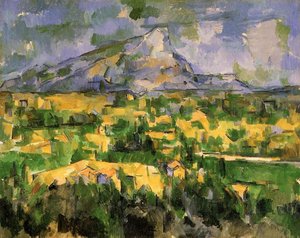
Cézanne’s style here is distinctly Post-Impressionistic. While building upon Impressionist principles of capturing light and atmosphere, he moves beyond fleeting impressions to investigate underlying structure. Notice the deliberate, visible brushstrokes – not blended seamlessly as in Impressionism, but rather applied with a confident energy that builds form through color. He employs a limited yet vibrant palette dominated by greens, yellows, and blues, subtly modulated to create depth and atmospheric perspective. This technique isn’t about replicating reality; it's about constructing a reasoned, almost geometric interpretation of it.
The painting showcases Cézanne’s innovative approach to depicting space. He utilizes horizontal planes – layers of color that draw the eye into the distance – creating a sense of depth and solidity rarely seen before his time. This technique would profoundly influence future generations of artists, particularly the Cubists.
Created during a period of significant artistic transition, Mont Sainte-Victoire embodies Cézanne’s rejection of purely optical representation. He sought to move beyond simply *seeing* nature and instead aimed to capture its underlying structure – its essential geometry. This pursuit positioned him as a crucial precursor to modern art movements like Cubism, which would dismantle traditional notions of perspective and form. His dedication to this approach, often met with initial incomprehension, ultimately cemented his legacy as “the father of us all” for artists like Picasso and Matisse.
Beyond its technical brilliance, Mont Sainte-Victoire evokes a profound sense of tranquility and harmony. The painting isn’t simply *of* nature; it feels imbued with the artist's deep connection to the land. The mountain itself symbolizes resilience, permanence, and the enduring beauty of the natural world. It invites contemplation and offers a visual refuge from the complexities of modern life.
This masterpiece would be a stunning focal point in a variety of settings. Its rich colors and dynamic composition lend themselves well to:
Consider framing this work in a classic, understated frame that complements its earthy tones without overpowering the artwork itself. Strategic lighting will enhance the texture and vibrancy of Cézanne’s brushstrokes, bringing the Provençal landscape to life.
Owning a reproduction of Mont Sainte-Victoire is an opportunity to bring a piece of art history—and a touch of timeless beauty—into your home or collection.
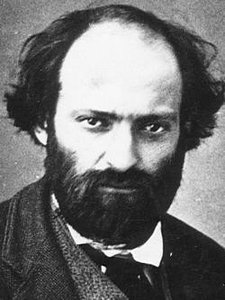
1839 - 1906 , France

Journey through Impressionism's heart with 10 iconic paintings by Monet, Renoir & Degas. Explore light, color & the stories behind these masterpieces. Find museum-quality art reproductions and elevate your home decor on BuyPopArt.com.

Explore the nuances of Impressionism & Post-Impressionism with . Expert insights for collectors on style, investment, and acquiring museum-quality reproductions.

Journey through Post-Impressionism's 10 defining masterpieces – Van Gogh, Monet & more. Explore iconic paintings, art history & find museum-quality reproductions for your home at . Discover all masterpieces online!
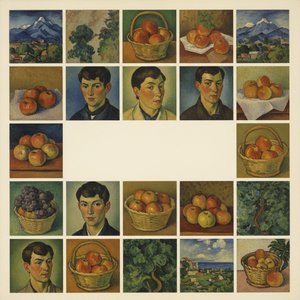
Journey through 25 iconic artworks by Paul Cézanne – a master of Impressionism and Post-Impressionism. Explore his landscapes, still lifes, and the stories behind these timeless masterpieces. Discover museum-quality reproductions & curated decor at BuyPopArt.com.

Explore the captivating world of Paul Huet (1803-1869), a master of French Romantic landscape painting. Discover his influence on Barbizon & Impressionism, and browse high-quality reproductions at BuyPopArt.


Stay updated with the latest art news, exclusive offers, and decoration ideas.
Tell us about your project and our art experts will provide you with 3 personalized art suggestions.
Let Us Curate 3 Options Just for You - Free!


 Buy print
 Send
Send Share
Share
 Details

 Download
 Similars
 X-Ray
X-Ray Diaporama


 Read More







 Glass option is only available in size under 110 CM