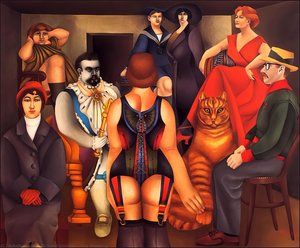
Museum-quality giclée or canvas print with fast production and flexible finish options. ( Buy Hand Made Painting Buy Image)





























Pick from our preset sizes that match the artwork's original proportions.

You may enter your own dimensions to fit a specific frame or space. If your selected size does not match the original image's proportions, we will either crop the artwork or extend the image with a mirrored or solid-fill edge. A digital mockup will be sent for your approval before production begins.
Please note that the on-screen preview does not reflect the actual cropping or extension. Only the mockup will accurately show the final composition.
While custom sizes are available, we recommend selecting a dimension from the predefined list to preserve the original proportions.
Worldwide Delivery () in 2 weeks instead of standard 4/5 weeks. (13 August)


Two
Reproduction Size
Richard Lindner, born in Hamburg, Germany, in 1901, remains one of the most singular and arresting figures in twentieth-century art. A German-American painter whose vision pulsed with a restless, mechanical energy, his work offers an unsettling yet captivating blend of urban eroticism and stylized form. His artistic journey was shaped by a profound duality, rooted in European traditions yet profoundly transformed by the vibrant, often contradictory landscape of New York City. Lindner did not merely paint scenes; he constructed psychological landscapes where the boundaries between human flesh and industrial precision seemed to dissolve, creating a visual language that continues to provoke and fascinate contemporary viewers.
The foundations of his aesthetic were laid in the disciplined environments of Germany. Following his family's move to Nuremberg, Lindner received a rigorous education at the Kunstgewerbeschule, where he honed his skills in design and craftsmanship. This early training in structure and form would later manifest in the almost architectural precision of his figures. His subsequent studies at the Kunstakademie in Munich exposed him to the Neue Sachlichkeit movement, a style defined by its stark realism and critical engagement with the social realities of the era. While Lindner eventually moved toward a more stylized, surrealist-inflected approach, the underlying tension between objective reality and symbolic distortion remained a permanent fixture of his creative psyche.
Lindner’s life was marked by the seismic shifts of mid-century history. His move to Berlin in 1927 placed him at the heart of a burgeoning avant-garde, but the rising tide of Nazism forced a pivotal exodus. Fleeing to Paris in 1933, Lindner entered a period of profound observation. Working as a commercial artist provided him with a unique vantage point, allowing him to absorb the diverse influences of the Parisian art scene while maintaining a professional connection to the aesthetics of mass media and advertising. This intersection of high art and commercial graphic design would become a cornerstone of his later mature style.
The eventual transition to the United States marked the true metamorphosis of his artistic voice. Immersed in the overwhelming scale and frenetic pace of New York City, Lindner found the perfect canvas for his explorations of modern alienation and desire. The city’s neon lights, crowded streets, and cinematic atmosphere provided the raw material for a new kind of figurative painting. His work began to evolve into the iconic imagery for which he is most celebrated: figures that appear both intensely human and strangely robotic, navigating spaces that feel simultaneously intimate and profoundly impersonal.
The mature works of Richard Lindner are characterized by a striking, almost sculptural approach to the human figure. His subjects often possess a smooth, mannequin-like quality, with limbs and torsos rendered in bold, simplified shapes that suggest both strength and vulnerability. This mechanical eroticism serves as a powerful commentary on gender roles and the impact of mass culture on individual identity. Through his use of exaggerated proportions and flattened perspectives, Lindner explored the tension between the biological and the artificial, creating a world where the human form is both celebrated and commodified.
Lindner’s achievements lie in his ability to synthesize disparate influences into a cohesive, unmistakable vision. His significance extends beyond mere stylistic innovation; he captured the psychological zeitgeist of an era defined by rapid urbanization and the rise of consumer culture. His legacy is found in:
Today, Richard Lindner is remembered as a visionary who dared to look at the modern world through a lens of beautiful distortion. His paintings remain vital, serving as hauntingly beautiful windows into the complexities of desire, identity, and the enduring spirit of the urban experience.
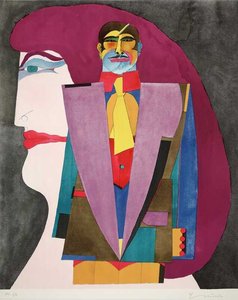
1901 - 1978 , Germany

Explore the captivating world of muted tones in art! Discover Tonalism's history, Whistler’s influence & how subtle color palettes evoke emotion. Find serene landscapes and expert advice for integrating these timeless pieces into your home with BuyPopArt.

Explore 10 iconic paintings bathed in captivating rosy brown tones! From Rembrandt to Titian, discover the stories behind these masterpieces & their warm color palettes. Find museum-quality art reproductions and decor inspiration at .

Fall in love with art! Explore 10 iconic romantic paintings – from Monet & Bouguereau to Fragonard. Discover the stories behind these masterpieces and find museum-quality reproductions for your home decor at .
Journey into the surreal world of Max Ernst! Explore 25 iconic paintings, from Dada to abstract expressionism. Discover the stories behind his masterpieces & find museum-quality art reproductions for your home decor at BuyPopArt.com.

Transform your cherished photos into timeless oil paintings with BuyPopArt's expert artists. Museum-quality reproductions & custom portraits, crafted to last a lifetime. Discover the art of personal legacy.


Stay updated with the latest art news, exclusive offers, and decoration ideas.
Tell us about your project and our art experts will provide you with 3 personalized art suggestions.
Let Us Curate 3 Options Just for You - Free!


 Preview
 Send
Send Share
Share
 Details

 Download
 Similars
 X-Ray
X-Ray Diaporama
 Read More







 Glass option is only available in size under 110 CM