

Impressions giclées ou sur toile de qualité musée, avec une production rapide et des finitions au choix. ( Passer à la peinture faite à la main Passer à l'image)





























Choisissez parmi nos formats prédéfinis qui respectent les proportions originales de l’œuvre.

Vous pouvez saisir vos propres dimensions pour vous adapter à un cadre ou à un espace spécifique. Si la taille sélectionnée ne correspond pas aux proportions de l'image originale, nous recadrerons l'œuvre ou étendrons l'image avec une bordure en miroir ou une couleur unie. Une maquette numérique vous sera envoyée pour approbation avant le début de la production.
Veuillez noter que l'aperçu à l'écran ne reflète pas le recadrage ou l'extension réelle. Seule la maquette montrera avec précision la composition finale.
Bien que des tailles personnalisées soient disponibles, nous vous recommandons de choisir une dimension dans la liste prédéfinie afin de préserver les proportions originales.
Livraison dans le monde entier () en 2 semaines au lieu des 4/5 semaines habituelles. (10 août)


Composition
Format de la reproduction
Alberto Burri's "Composition," painted in 1953, isn’t merely a landscape; it’s a visceral embodiment of post-war Italy grappling with the ruins of its past and the uncertain promise of the future. Born amidst the devastation of World War II, Burri’s artistic journey was profoundly shaped by his experiences as a prisoner of war in Texas, an event that instilled within him a deep sense of fragmentation and loss – emotions powerfully reflected in this seminal work. The painting immediately confronts the viewer with its raw materiality; it's not about depicting a scene but rather presenting the very elements of construction itself—burlap, fabric scraps, wood fragments, and other found objects meticulously assembled onto a canvas. This deliberate rejection of traditional representation aligns Burri squarely within the burgeoning Arte Povera movement, an Italian artistic current that championed the use of humble, everyday materials to challenge conventional notions of beauty and value.
The composition itself is deliberately chaotic yet strangely balanced. Large, irregularly shaped patches dominate the canvas, each bearing the distinct texture of its constituent material – the coarse weave of burlap, the rough edges of wood, the yielding softness of fabric. There’s no single focal point to draw the eye; instead, the viewer is invited on a meandering journey across the surface, encountering these disparate elements and considering their interplay. The seams where the patches meet are visible, not concealed, emphasizing the act of construction and highlighting the inherent tension between order and disorder. This deliberate lack of hierarchy mirrors Burri’s own experience – a world shattered and reassembled, yet never fully restored.
Burri's masterful manipulation of texture is central to "Composition’s" impact. He doesn’t smooth or refine the materials; instead, he embraces their inherent imperfections – tears, wrinkles, burns, and stains—as integral components of the artwork. The burlap, for instance, appears weathered and worn, suggesting a history of labor and hardship. The wood fragments bear the marks of time and decay, hinting at the collapse of structures and the passage of years. This tactile quality invites the viewer to engage with the work on a sensory level, prompting an emotional response beyond mere visual appreciation. It’s as if Burri is inviting us to touch the remnants of a broken world and contemplate its enduring power.
The color palette further reinforces this sense of decay and resilience. The dominant tones are earthy – browns, tans, beiges, and greys—evoking images of dust, soil, and stone. Sparse accents of red and blue provide subtle points of visual interest, like flashes of memory or the lingering traces of violence. These muted colors contribute to a feeling of age and wear, suggesting that the artwork has witnessed significant events and endured considerable hardship. The overall effect is one of melancholic beauty—a testament to the ability of art to transform trauma into something meaningful.
Beyond its purely material qualities, “Composition” resonates with profound symbolic weight. It’s widely believed that Burri's experiences as a prisoner of war deeply influenced his artistic vision. The fragmented nature of the composition mirrors the shattered state of his own psyche—a world torn apart by violence and loss. The act of assembling disparate materials into a cohesive whole can be interpreted as an attempt to rebuild, to create order from chaos, to find meaning in destruction. The title itself, “Composition,” suggests a deliberate effort to impose structure on a fragmented reality.
Furthermore, the painting’s connection to the Cretto di Gibellina—the monumental sculpture created by Burri on the ruins of his hometown after the devastating 1968 earthquake—is significant. The Cretto, like “Composition,” is a testament to resilience and a memorial to those who perished in the disaster. Both works confront the viewer with the stark reality of destruction while simultaneously celebrating the enduring spirit of humanity. The painting’s raw materiality and evocative textures serve as a powerful reminder of the fragility of life and the importance of confronting our past.
Alberto Burri’s “Composition” stands as a pivotal work in the history of 20th-century art, profoundly influencing generations of artists. His pioneering use of unconventional materials and his exploration of themes such as trauma, memory, and resilience continue to resonate today. Reproductions of this powerful artwork offer a unique opportunity to experience Burri’s vision firsthand, inviting viewers to contemplate the complexities of human existence and the enduring beauty that can be found even in the face of adversity. It is a piece that demands attention, prompting reflection on the nature of art, memory, and the human condition.
Alberto Burri était un peintre et sculpteur italien considéré comme une figure clé de l'art d'après-guerre. Il est associé à des mouvements tels que le néo-dada, le nouveau réalisme, le postminimalisme et l'arte povera. Son œuvre se caractérise par son utilisation innovante de matériaux non conventionnels et un intérêt pour la matérialité de l'art lui-même.
L'expérience d'être un prisonnier de guerre s'est avérée déterminante, lui offrant le temps et l'espace nécessaires pour se consacrer à la peinture sans formation formelle. La mort tragique de son frère pendant la guerre l'a également profondément affecté.
Le développement artistique de Burri était marqué par une exploration constante des matériaux et des processus, s'éloignant des techniques traditionnelles de peinture vers une approche plus sculpturale et axée sur les matériaux.
L’importance d’Alberto Burri réside dans son utilisation pionnière des matériaux et son rejet des conventions artistiques traditionnelles. Il est considéré comme une figure clé de l'arte povera et a influencé les générations futures d'artistes qui ont exploré la matérialité et le processus dans leur travail. Son projet monumental *Grande cretto* témoigne de son ambition et de sa vision, consolidant ainsi sa place dans l’histoire de l’art contemporain.

1915 - 1995 , Italie

Explorez en profondeur le mouvement artistique de la Renaissance italienne : ses innovations techniques, ses grands maîtres (Léonard de Vinci, Michel-Ange), et l'essor de l'humanisme. Un voyage au cœur d'une époque exceptionnelle.

Explore the captivating world of Alberto Pasini (1826-1899), a master of Orientalist scenes and Venetian landscapes. Discover his stunning paintings & learn about his legacy at BuyPopArt.
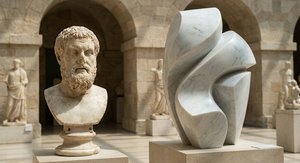
Explore the captivating history of marble sculpture from ancient Greece to modern art. Discover renowned artists like Canova & Michelangelo, carving techniques, and investment insights at BuyPopArt.

Explore the revolutionary art of Giotto di Bondone! Discover his groundbreaking techniques, iconic frescoes like those in the Arena Chapel, and lasting impact on Renaissance painting. A deep dive for art enthusiasts.

Explore the captivating world of monochrome art! Discover its rich history, influential artists like Malevich & Klein, and profound emotional impact. Expert insights for collectors & design enthusiasts.


Restez informé(e) des dernières actualités artistiques, des offres exclusives et des idées de décoration.
Parlez-nous de votre projet et nos experts en art vous proposeront 3 suggestions d'œuvres personnalisées.
Laissez-nous sélectionner 3 œuvres rien que pour vous – Gratuit !


 Aperçu en situation
 Envoyer
 Partager
 Détails de l'œuvre

 Télécharger
 Articles similaires
 Radiographie
 Diaporama


 Lire la suite







 L'option verre n'est disponible que pour les dimensions inférieures à 110 cm.


