

 Oil On CanvasWallArtRomanticism
 191319th Century
 29.0 x 39.0 cm
 Llyfrgell Genedlaethol Cymru / The National Library of Wales
Impressions giclées ou sur toile de qualité musée, avec une production rapide et des finitions au choix. ( Commander la reproduction peinte à la main Télécharger l'image haute résolution)





























Choisissez parmi nos formats prédéfinis qui respectent les proportions originales de l’œuvre.

Vous pouvez saisir vos propres dimensions pour vous adapter à un cadre ou à un espace spécifique. Si la taille sélectionnée ne correspond pas aux proportions de l'image originale, nous recadrerons l'œuvre ou étendrons l'image avec une bordure en miroir ou une couleur unie. Une maquette numérique vous sera envoyée pour approbation avant le début de la production.
Veuillez noter que l'aperçu à l'écran ne reflète pas le recadrage ou l'extension réelle. Seule la maquette montrera avec précision la composition finale.
Bien que des tailles personnalisées soient disponibles, nous vous recommandons de choisir une dimension dans la liste prédéfinie afin de préserver les proportions originales.
Livraison dans le monde entier () en 2 semaines au lieu des 4/5 semaines habituelles. (16 août)


Cader Idris
Format de la reproduction
To gaze upon this depiction of Cader Idris is to be transported to a realm where the grandeur of nature meets an almost palpable sense of peace. Christopher Williams, in this evocative landscape from 1913, has captured more than just mountains; he has bottled the very spirit of the Welsh uplands. The composition immediately draws the eye into a breathtaking panorama dominated by majestic peaks piercing a cerulean sky. These are not merely geological formations; they feel imbued with history and myth. Williams masterfully balances the solidity of the rock faces against the ephemeral dance of the clouds, creating a visual dialogue between permanence and transience that speaks directly to the human soul.
Williams’s handling of light and atmosphere is nothing short of masterful. Observe how the blue of the sky deepens into softer hues near the horizon, suggesting either dawn's gentle awakening or the quietude of a late afternoon. The clouds are rendered with such delicate touch that they seem ready to drift down and settle upon the viewer. Complementing this vast expanse are the scattered trees, placed thoughtfully across the foreground and mid-ground. These elements serve not only to anchor the composition but also to provide scale, allowing the viewer to truly appreciate the towering immensity of the mountains behind them. The technique employed suggests a deep understanding of tonal variation, giving the entire scene a rich, almost velvety depth that invites prolonged contemplation.
For those familiar with Williams’s oeuvre, this piece resonates deeply with his commitment to celebrating Welsh identity through art. While he is celebrated for his portraits and allegories, his landscapes often served as conduits for a national spirit—a sense of enduring resilience rooted in the dramatic beauty of his homeland. The inclusion of Cader Idris, such an iconic landmark, grounds the painting in a specific cultural geography. It suggests that this landscape was more than just scenery to him; it was part of a narrative, a visual testament to the enduring character of Wales itself.
Bringing this piece into your home or design space is an act of curating tranquility. The emotional impact of this artwork is one of profound calm. It acts as a natural focal point, capable of softening the sharp edges of modern life. For collectors and designers alike, it offers unparalleled depth without overwhelming a room. Whether placed in a study to inspire contemplation or in a living area to evoke weekend wanderings, its serene palette and monumental subject matter promise an immediate sense of upliftment and connection to something timeless and wild.
Christopher David Williams (1873-1934) était un artiste gallois renommé dont la carrière s’étendait de la fin de la période victorienne au début du XXe siècle. Il est particulièrement mémorisé pour ses portraits évocateurs, scènes allégoriques et paysages qui reflétaient souvent un fort sentiment d'identité galloise et l'esprit du renouveau celtique.
Né à Maesygwrath, au Pays de Galles, Williams a initialement rencontré l’opposition de son père, Evan Williams, qui envisageait une carrière médicale pour lui. Cependant, une visite transformatrice à la Walker Art Gallery de Liverpool en 1892, où il a été profondément touché par *Pérse et Andromède* de Frederick Leighton, a enflammé sa passion pour l’art. Cette expérience a renforcé sa détermination à poursuivre une vie d'artiste.
Le travail de Williams se caractérise par:
Christopher Williams a joué un rôle important dans la promotion de l'art et de la culture galloise pendant sa vie. Il a participé activement à l’Eisteddfod national en tant qu’arbitre et a siégé au comité du Musée National du Pays de Galles et à la Honourable Society of Cymmrodorion. Son travail reflète un fort sentiment d'identité nationale et a contribué à la floraison artistique du Pays de Galles au début du XXe siècle.
Ses peintures sont conservées dans de nombreuses collections publiques, notamment le Musée National du Pays de Galles, la Collection Royale et la Glynn Vivian Art Gallery, assurant ainsi que son héritage continue d'inspirer et de captiver les publics aujourd’hui. Il était beau-frère de l'artiste Fred Appleyard, et père d'astronome Evan Gwyn Williams et d'artiste Ivor Williams.

1873 - 1934 , États-Unis d'Amérique
Découvrez les 10 plus beaux paysages de l'histoire de l'art : Monet, Van Gogh et bien d'autres. Explorez leur technique unique et trouvez l'inspiration pour votre décoration intérieure avec BuyPopArt.com. Œuvres exceptionnelles à découvrir !

Plongez dans l'émotion du Romantisme avec les 10 plus beaux paysages de Friedrich, Turner & Delacroix. Découvrez leur histoire et trouvez l'inspiration déco idéale sur BuyPopArt.com !
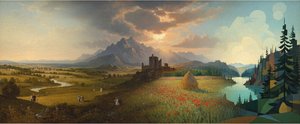
Explorez l'histoire fascinante de la peinture de paysage à travers les chefs-d'œuvre du Romantisme. Découvrez Friedrich, Turner et Aivazovski et laissez-vous inspirer par la beauté sauvage et le sublime. Reproduction d'art de qualité chez BuyPopArt.
Plongez dans l'univers de John Constable avec les 25 œuvres incontournables du maître anglais. Découvrez l'histoire, la technique et l'émotion derrière ses paysages romantiques. Reproductions de qualité muséale sur BuyPopArt.com.

Explore the rich history of landscape painting! Discover renowned artists, movements like Romanticism, & techniques such as atmospheric perspective. Find inspiration and quality reproductions at BuyPopArt.


Restez informé(e) des dernières actualités artistiques, des offres exclusives et des idées de décoration.
Parlez-nous de votre projet et nos experts en art vous proposeront 3 suggestions d'œuvres personnalisées.
Laissez-nous sélectionner 3 œuvres rien que pour vous – Gratuit !


 Aperçu en situation
 Envoyer
 Partager
 Détails de l'œuvre

 Télécharger
 Articles similaires
 Radiographie
 Diaporama
 Lire la suite







 L'option verre n'est disponible que pour les dimensions inférieures à 110 cm.


