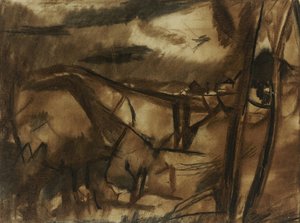
Oil On PanelCubist Abstraction
 1913
1913 41.0 x 33.0 cm
 Bristol Museum - Art Gallery
Impressions giclées ou sur toile de qualité musée, avec une production rapide et des finitions au choix. ( Commander la reproduction peinte à la main Télécharger l'image haute résolution)





























Choisissez parmi nos formats prédéfinis qui respectent les proportions originales de l’œuvre.

Vous pouvez saisir vos propres dimensions pour vous adapter à un cadre ou à un espace spécifique. Si la taille sélectionnée ne correspond pas aux proportions de l'image originale, nous recadrerons l'œuvre ou étendrons l'image avec une bordure en miroir ou une couleur unie. Une maquette numérique vous sera envoyée pour approbation avant le début de la production.
Veuillez noter que l'aperçu à l'écran ne reflète pas le recadrage ou l'extension réelle. Seule la maquette montrera avec précision la composition finale.
Bien que des tailles personnalisées soient disponibles, nous vous recommandons de choisir une dimension dans la liste prédéfinie afin de préserver les proportions originales.
Livraison dans le monde entier () en 2 semaines au lieu des 4/5 semaines habituelles. (18 août)


Figure Composition
Format de la reproduction
David Bomberg’s “Figure Composition,” painted in 1913, isn't merely a depiction of two figures; it’s an architectural meditation on form, movement, and the burgeoning anxieties of a rapidly changing world. Housed within the Bristol Museum & Art Gallery, this oil-on-panel work stands as a pivotal example of Bomberg’s early experimentation with Cubism and his exploration of urban space – a testament to a generation grappling with modernity's fractured realities.
The painting immediately commands attention through its bold, reductive geometry. Two figures, rendered in stark black, white, red, and brown, are not presented as recognizable human forms but rather as abstracted blocks of shape and line. These aren’t the soft curves of Impressionism or the detailed realism of earlier styles; instead, Bomberg employs sharp angles, intersecting planes, and a deliberate flattening of perspective to create a dynamic sense of spatial ambiguity. The figures seem to be locked in an embrace, yet their solidity is undermined by the fragmented nature of their representation – suggesting both connection and isolation simultaneously.
Bomberg’s approach was deeply influenced by the avant-garde movements circulating at the time. The exhibition of Paul Cézanne's work in 1910, particularly his emphasis on geometric simplification and multiple viewpoints, proved transformative. Furthermore, Bomberg’s exposure to Cubism through artists like Picasso and Braque—and later, the energetic dynamism of Futurism—fueled his desire to break free from traditional representation. “Figure Composition” embodies this fusion; it retains a certain structural rigor reminiscent of Cubism while injecting a sense of movement and energy that echoes the Futurist fascination with speed and industrialization.
However, Bomberg’s work transcends mere stylistic imitation. He wasn't simply copying these movements; he was actively synthesizing them into a distinctly personal language. The painting’s restrained color palette—a carefully considered interplay of warm and cool tones—and the deliberate use of negative space contribute to an atmosphere of contained tension. The background, divided into two distinct planes of orange, acts as a visual anchor, preventing the composition from dissolving entirely into abstraction.
Painted in 1913, “Figure Composition” is inextricably linked to the tumultuous events unfolding in Europe at the time. The First World War was looming on the horizon, and artists were increasingly preoccupied with themes of fragmentation, alienation, and the breakdown of established order. Bomberg’s fractured figures can be interpreted as a visual metaphor for this sense of societal disintegration – a reflection of the anxieties and uncertainties that permeated the era.
The painting's composition also subtly evokes the urban landscape of London, where Bomberg spent much of his life. The interlocking forms suggest the dense network of streets and buildings, while the sharp angles reflect the hard edges of industrial architecture. It’s a powerful statement about the relationship between humanity and its environment – a dialogue between individual figures and the impersonal forces shaping their world.
“Figure Composition” is more than just a beautiful painting; it's a crucial document in the history of modern art. David Bomberg’s willingness to experiment, his embrace of abstraction, and his exploration of complex themes continue to resonate with viewers today. This work demonstrates his early mastery of geometric abstraction and his ability to infuse it with emotional depth – solidifying his place as one of Britain's most important avant-garde artists.
Né dans une famille immigrante polonaise-juive, Abraham et Rebecca Bomberg, à Birmingham. La famille a déménagé à Whitechapel, Londres, en 1895.
A étudié initialement à la City and Guilds Technical Art School avant de se former comme lithographe à Birmingham.
A étudié sous Walter Sickert à Westminster School of Art (1908-1910), où il a été influencé par l'accent mis par Sickert sur la forme et la vie urbaine.
Exposition significative à Paul Cézanne grâce à l'exposition de 1910 de Roger Fry "Manet et les post-impressionnistes".
A fréquenté la Slade School of Art (1911), remportant le prix Tonks pour son dessin du camarade étudiant Isaac Rosenberg.
Les expériences en tant que soldat pendant la Première mondiale ont profondément influencé sa vision artistique, conduisant à un éloignement de l'abstraction.
Dans les années 1920, Bomberg a adopté un style plus figuratif, se concentrant sur des portraits et des paysages tirés directement de la nature.
A développé une technique expressionniste de plus en plus marquée, caractérisée par un impasto texturé et une intensité émotionnelle.
De nombreux voyages à travers le Moyen-Orient (en particulier la Palestine) et l'Europe ont considérablement influencé son œuvre ultérieure. Ses représentations de Jérusalem sont particulièrement notables.

1890 - 1957 , Royaume-Uni

Discover the power of Neo-Abstract art. Explore how bold geometric forms and high-impact visual energy are redefining modern design. Learn to curate sophisticated, high-energy spaces with the latest trends in contemporary abstraction and structural color.

Discover the high-impact world of Geometric Abstraction. From Cubist roots to modern urban trends, explore how bold shapes and colors redefine contemporary design. Elevate your space with expert art insights and custom-made abstract masterpieces.


Restez informé(e) des dernières actualités artistiques, des offres exclusives et des idées de décoration.
Parlez-nous de votre projet et nos experts en art vous proposeront 3 suggestions d'œuvres personnalisées.
Laissez-nous sélectionner 3 œuvres rien que pour vous – Gratuit !


 Aperçu en situation
 Envoyer
 Partager
 Détails de l'œuvre

 Télécharger
 Articles similaires
 Radiographie
 Diaporama
 Lire la suite







 L'option verre n'est disponible que pour les dimensions inférieures à 110 cm.