Impressions giclées ou sur toile de qualité musée, avec une production rapide et des finitions au choix. ( Passer à la peinture faite à la main Passer à l'image)





























Choisissez parmi nos formats prédéfinis qui respectent les proportions originales de l’œuvre.

Vous pouvez saisir vos propres dimensions pour vous adapter à un cadre ou à un espace spécifique. Si la taille sélectionnée ne correspond pas aux proportions de l'image originale, nous recadrerons l'œuvre ou étendrons l'image avec une bordure en miroir ou une couleur unie. Une maquette numérique vous sera envoyée pour approbation avant le début de la production.
Veuillez noter que l'aperçu à l'écran ne reflète pas le recadrage ou l'extension réelle. Seule la maquette montrera avec précision la composition finale.
Bien que des tailles personnalisées soient disponibles, nous vous recommandons de choisir une dimension dans la liste prédéfinie afin de préserver les proportions originales.
Livraison dans le monde entier () en 2 semaines au lieu des 4/5 semaines habituelles. (11 août)


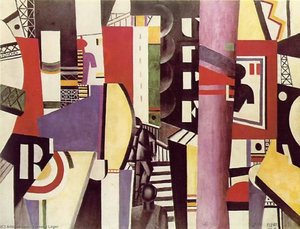
Roofs
Format de la reproduction
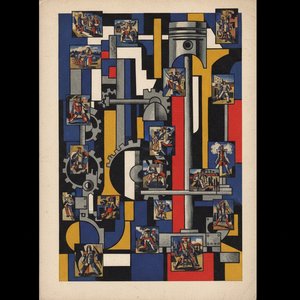
Fernand Léger's "Roofs," painted during a period of profound societal transformation, is more than just a depiction of a city scene; it’s a visceral embodiment of the anxieties and aspirations surrounding the rise of industrial modernity. The painting immediately commands attention with its dramatic composition – buildings choked by billowing smoke, figures scattered amidst the chaos, and two birds seemingly adrift in this turbulent landscape. Léger, born Joseph Fernand Henri Léger in 1881 in Argentan, Normandy, was a key figure in the development of Cubism, yet his work transcends simple geometric abstraction. He sought to translate the impact of the machine age – its raw power, its fragmented forms, and its unsettling influence on human life – into a powerfully expressive visual language.
Léger’s artistic journey began with an interest in architecture, but his relocation to Paris around 1900 proved transformative. He quickly immersed himself in the burgeoning avant-garde scene, rejecting purely abstract approaches that distanced art from reality. Instead, he embraced a method of “analytical cubism,” meticulously dissecting objects and figures into geometric components – cylinders, cones, and planes – before reassembling them in a fragmented yet dynamic composition. In "Roofs," this technique is evident in the angular forms of the buildings, rendered with a deliberate sense of distortion that reflects their mechanical nature. The smoke itself isn’t merely atmospheric; it's a visual representation of the industrial processes churning at the heart of the city, a tangible manifestation of its relentless energy.
The inclusion of two birds within the composition is particularly significant. Often interpreted as symbols of freedom and escape, their presence amidst the urban turmoil suggests a yearning for respite from the pressures of modern life. The scattered figures, rendered with varying degrees of detail, contribute to the painting’s sense of unease and urgency. They are not heroic or idealized; rather, they represent ordinary individuals grappling with the consequences of rapid industrialization – perhaps overwhelmed by its scale, or searching for meaning within its disorienting landscape. Léger masterfully evokes a feeling of both fascination and apprehension, inviting the viewer to contemplate the complex relationship between humanity and technology.
Léger’s technique in “Roofs” is characterized by bold brushstrokes and a deliberate use of color. While the palette leans towards muted tones – grays, browns, and ochres – punctuated by flashes of red and yellow within the smoke, this restraint amplifies the painting's dramatic impact. The artist employed a layering technique, building up the composition through multiple applications of paint, creating a textured surface that adds to the sense of depth and dynamism. This meticulous approach is characteristic of Léger’s commitment to capturing the essence of form and texture, reflecting his fascination with the physicality of industrial materials.
"Roofs" stands as a powerful testament to Fernand Léger's pioneering vision. It is a painting that speaks directly to our contemporary concerns about urbanization, technological advancement, and the human condition in an age of rapid change. Its enduring appeal lies not only in its formal qualities – its masterful use of cubist principles – but also in its profound emotional resonance. A hand-painted reproduction of this artwork offers a unique opportunity to experience Léger’s artistic genius firsthand, bringing a touch of modernist drama and intellectual depth to any interior space.
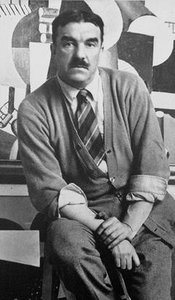
1881 - 1955 , France

Explore the rich history of figure painting from antiquity to the Renaissance! Discover iconic artworks, masterful techniques & enduring symbolism. Find museum-quality reproductions at BuyPopArt.
Explorez l'esthétique industrielle dans l'art moderne : des origines philosophiques au brutalisme, en passant par les chartes du design. Découvrez comment la production a influencé les formes artistiques et collectionnez des œuvres emblématiques.

Plongez dans l'âme industrielle de 10 chefs-d'œuvre emblématiques ! Découvrez les histoires fascinantes de Van Gogh, Monet et d'autres artistes ayant capturé la beauté brute du monde moderne. Reproductions de qualité musée sur BuyPopArt.com – Explorez la collection en ligne.

Plongez au cœur du cubisme avec ! Découvrez les 10 chefs-d'œuvre de Picasso, Braque et autres artistes révolutionnaires. Reproductions d'art haute qualité pour une décoration intérieure unique. Explorez la collection sur
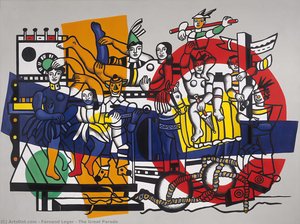
Plongez dans l'univers vibrant de Fernand Léger ! Découvrez les 25 œuvres majeures du cubisme et du tubisme, explorant formes géométriques et couleurs audacieuses. Retrouvez des reproductions d'art exceptionnelles sur BuyPopArt.com.


Restez informé(e) des dernières actualités artistiques, des offres exclusives et des idées de décoration.
Parlez-nous de votre projet et nos experts en art vous proposeront 3 suggestions d'œuvres personnalisées.
Laissez-nous sélectionner 3 œuvres rien que pour vous – Gratuit !


 Aperçu en situation
 Envoyer
 Partager
 Détails de l'œuvre

 Télécharger
 Articles similaires
 Radiographie
 Diaporama

 Lire la suite







 L'option verre n'est disponible que pour les dimensions inférieures à 110 cm.