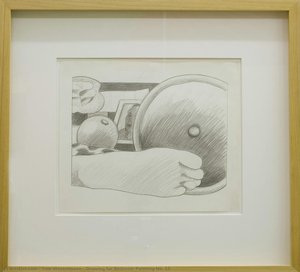
Acrylic On PaperNeo-Dada
 1958
1958 21.0 x 29.0 cm
 Tate Modern
Huile sur toile peinte à la main, avec cadre et dimensions personnalisés, réalisée sur commande par nos artistes. ( Acheter l'impression Acheter l'image)





























Choisissez parmi nos formats prédéfinis qui respectent les proportions originales de l’œuvre.

Vous pouvez saisir vos propres dimensions pour l'adapter à un cadre ou à un espace spécifique. Si la taille sélectionnée ne correspond pas aux proportions de l'image d'origine, nous recadrerons l'œuvre ou prolongerons la peinture avec des éléments peints à la main supplémentaires. Une maquette numérique vous sera envoyée pour approbation avant le début de la production.
Veuillez noter que l'aperçu à l'écran ne reflète pas le recadrage ou l'extension réels. Seule la maquette montrera fidèlement la composition finale.
Bien que des tailles personnalisées soient disponibles, nous vous recommandons de sélectionner une dimension dans la liste prédéfinie afin de préserver les proportions d'origine.
Livraison dans le monde entier () en 3 à 4 semaines au lieu des 5 semaines habituelles. (12 août). Aucun compromis sur la qualité.


Actresses
Format de la reproduction
Joseph Beuys's "Actresses," rendered in 1958 on a deceptively simple pale beige background, isn’t merely a sketch; it’s a distilled essence of performance, vulnerability, and the potent symbolism inherent within the human form. This preparatory drawing, a glimpse into the mind of one of the 20th century's most radical artists, immediately draws the viewer in with its loose, gestural lines – a deliberate rejection of rigid representation in favor of capturing a fleeting moment of embodied expression. The two figures, presented in profile and seemingly caught mid-movement, possess an immediate theatricality, hinting at dancers, performers, or perhaps even the silent drama of everyday life. Beuys wasn’t interested in replicating reality; he sought to translate feeling onto paper, imbuing his subjects with a palpable sense of energy and contained emotion.
The composition is strikingly asymmetrical, defying traditional notions of balance. The figures aren’t centered within the frame, instead occupying distinct points that create a dynamic imbalance—a visual representation of movement itself. Vertical lines, subtly introduced from the top edge, provide an anchor and structure to this otherwise fluid arrangement, preventing the drawing from dissolving into pure abstraction. Beuys's technique is characterized by a masterful use of hatching and cross-hatching, skillfully employed to build volume and shadow without resorting to precise shading. The loose, sketchy lines, rendered with charcoal or graphite, contribute significantly to the overall sense of spontaneity and immediacy—as if the artist were capturing a fleeting impression rather than meticulously crafting a finished image. Notice how he uses varying line weights to emphasize certain areas, drawing attention to the contours of the figures’ limbs and torsos.
The muted color palette—dominated by earthy browns, ochres, and subtle touches of purple—reinforces the drawing's emotional depth. The beige background acts as a neutral canvas, allowing the figures to command attention without distraction. The small area of mauve on one figure introduces an element of mystery or perhaps even melancholy, hinting at hidden emotions beneath the surface. Beyond mere color choices, Beuys’s use of earth tones speaks to a deep connection with nature and the primal roots of human experience. Considering his later work focused heavily on social sculpture and the integration of art into everyday life, this grounding in natural materials and forms is profoundly significant. The elongated figures themselves can be interpreted as symbols of theatricality—a deliberate exaggeration that highlights the performative aspect of existence.
“Actresses” was created during a period of immense social and political upheaval in post-war Germany, a time when artists were grappling with questions of identity, purpose, and the role of art in society. Beuys’s work reflects this broader context, aligning with the burgeoning Expressionist movement and foreshadowing the rise of Fluxus and other avant-garde artistic practices. The drawing's emphasis on gesture and emotion anticipates the performance art that would become increasingly prominent in the latter half of the 20th century. Furthermore, it shares affinities with Surrealism, particularly in its exploration of the subconscious and its use of symbolic imagery. It’s worth noting that Beuys himself was deeply influenced by Carl Linnaeus's *Systema Naturae*, a book he rescued from a Nazi book burning—an event that profoundly shaped his artistic philosophy and his belief in art as a tool for social transformation. The drawing, therefore, can be seen as a meditation on the fragility of existence and the enduring power of human connection.
This preparatory sketch offers a rare glimpse into the creative process of one of the 20th century’s most visionary artists. “Actresses” is more than just a drawing; it's a testament to Beuys’s profound understanding of the human condition and his unwavering commitment to exploring the transformative potential of art.
Joseph Beuys était un artiste allemand profondément influent qui a transcendé les frontières artistiques traditionnelles. Il est reconnu comme une figure clé du Fluxus, des Happenings et de l'art de la performance, mais son impact s’étend bien au-delà de ces mouvements. Son œuvre englobait la sculpture, l'installation, le graphisme, la théorie et la pédagogie, tous entrelacés avec les concepts d'humanisme, de philosophie sociale et d'anthroposophie. Sa contribution la plus significative était sans doute le concept de "Sculpture Sociale" (Soziale Plastik), une vision holistique où la créativité joue un rôle vital dans la formation de la société et de la politique – un Gesamtkunstwerk impliquant un engagement participatif.
Né dans une famille de commerçants, Beuys a connu des déménagements de Krefeld à Kleve au début de sa vie. Son éducation a révélé une aptitude pour le dessin et un large éventail d'intérêts, notamment la musique (piano et violoncelle), l’histoire nordique, la mythologie et les sciences naturelles. Un moment décisif s’est produit en 1933 lorsque, alors qu’il était encore jeune, il a sauvé le Systema Naturae de Carl Linnaeus d'un bûcher de livres nazis – un événement qui allait plus tard résonner dans sa pratique artistique.
Après la Seconde Guerre mondiale, Beuys a étudié à l’Académie des beaux-arts de Düsseldorf sous la direction de Joseph Enseling puis d’Ewald Mataré. Son engagement avec l'anthroposophie, en particulier la philosophie de Rudolf Steiner, a profondément façonné sa vision du monde et son approche artistique. Il s'est éloigné de l'art représentatif traditionnel pour adopter une pratique plus conceptuelle et axée sur le processus.
La pratique artistique de Beuys était incroyablement diversifiée, englobant l'art de la performance, les installations, les dessins, les sculptures et l’activisme politique. Il utilisait fréquemment des matériaux non conventionnels tels que de la feutre, de la graisse, du miel, de l'argile, de l'asphalte et des pierres, leur conférant une signification symbolique. Ses performances impliquaient souvent des actions rituelles et un engagement direct avec le public.
Joseph Beuys est largement considéré comme l’un des artistes les plus importants du XXe siècle. Son approche radicale de l’art a remis en question les notions conventionnelles de créativité et d'auteur, en mettant l’accent sur le rôle de la participation et de l’engagement social. Il a élargi la définition de l’art au-delà des préoccupations esthétiques pour englober les dimensions politiques, environnementales et spirituelles. Son concept de Sculpture Sociale continue d’inspirer les artistes, les militants et les penseurs aujourd'hui, consolidant ainsi son héritage en tant que visionnaire qui cherchait à transformer à la fois l'art et la société.

1921 - 1986 , Allemagne

Elevate your artistry with our expert guide to mastering graphite pencil. Learn professional techniques for achieving profound depth, intricate textures, and hyper-realistic details through advanced shading, layering, and precision tool mastery designed for serious art students.

Master the raw power of graphite art. From hyper-realistic textures to high-contrast shadows, discover expert techniques for creating impactful monochrome masterpieces that command attention in any modern space.

Elevate your space with the raw energy of sketch studies. Discover how the unfiltered power of charcoal, line, and gesture creates the ultimate urban vibe for modern interiors. Expert trends in contemporary wall art curation for the design-conscious professional.

Master the raw energy of contemporary drawing. Explore how street art, bold graphic lines, and urban grit are redefining modern aesthetics. Discover expert trend forecasts for collecting high-impact, pop-culture-inspired pieces that transform any space with unapologetic power.

Elevate your space with bold, iconic dance art. From street art vibes to Pop Art masterpieces, discover high-impact, hand-painted reproductions and custom commissions designed to move you. Transform your walls with the rhythm of contemporary culture.


Restez informé(e) des dernières actualités artistiques, des offres exclusives et des idées de décoration.
Parlez-nous de votre projet et nos experts en art vous proposeront 3 suggestions d'œuvres personnalisées.
Laissez-nous sélectionner 3 œuvres rien que pour vous – Gratuit !


 Aperçu en situation
 Envoyer
 Partager
 Détails de l'œuvre

 Télécharger
 Articles similaires
 Radiographie
 Diaporama
 Lire la suite







 L'option verre n'est disponible que pour les dimensions inférieures à 110 cm.