DrawingWallArtGeorgian
 1760Early Modern
 8.0 x 14.0 cm
 Leeds Museums - Galleries
Huile sur toile peinte à la main, avec cadre et dimensions personnalisés, réalisée sur commande par nos artistes. ( Commander l'impression Télécharger l'image haute résolution)
Choisissez parmi nos formats prédéfinis qui respectent les proportions originales de l’œuvre.

Vous pouvez saisir vos propres dimensions pour l'adapter à un cadre ou à un espace spécifique. Si la taille sélectionnée ne correspond pas aux proportions de l'image d'origine, nous recadrerons l'œuvre ou prolongerons la peinture avec des éléments peints à la main supplémentaires. Une maquette numérique vous sera envoyée pour approbation avant le début de la production.
Veuillez noter que l'aperçu à l'écran ne reflète pas le recadrage ou l'extension réels. Seule la maquette montrera fidèlement la composition finale.
Bien que des tailles personnalisées soient disponibles, nous vous recommandons de sélectionner une dimension dans la liste prédéfinie afin de préserver les proportions d'origine.
Livraison dans le monde entier () en 3 à 4 semaines au lieu des 5 semaines habituelles. (16 août). Aucun compromis sur la qualité.


Drawing for a table
Format de la reproduction
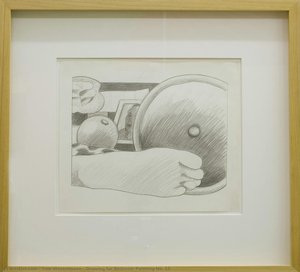
In the delicate lines of this 1760 drawing for a table, we find more than just a blueprint for furniture; we encounter a window into the refined soul of the Georgian era. Created by the legendary English cabinet-maker Thomas Chippendale, this exquisite work serves as a testament to an age where utility and artistry were inextricably linked. The drawing captures the essence of a pier or sideboard table, envisioned with a luxurious top of either polished marble or deep, rich mahogany. As the eye wanders across the composition, one perceives the meticulous planning of a master craftsman, whose hand was capable of translating grand architectural ambitions into the intimate scale of domestic splendor. The frame and legs, suggested to be finished in gold gilt or sophisticated paint, promise a piece that would not merely occupy a room but command it with an effortless, regal grace.
The technique employed here is one of precision and evocative suggestion. Through masterful use of line and subtle shading, Chippendale breathes life into the inanimate, creating a sense of depth and texture that invites the viewer to imagine the tactile reality of the finished object. The intricate carvings and ornamentation described in the composition reflect the Rococo influence that permeated the mid-18th century, characterized by flowing curves and organic motifs. This drawing is not merely a technical guide but an artistic performance, where every stroke contributes to a larger narrative of elegance. For the discerning collector or interior designer, this piece offers a profound study in how ornamentation can enhance structure without overwhelming it, providing a timeless blueprint for sophisticated spatial arrangement.
To understand this drawing is to understand the revolutionary impact of Thomas Chippendale himself. Operating from his workshop in St. Martin's Lane, London, Chippendale was a pioneer who bridged the gap between the artisan and the auteur. His seminal work, The Gentleman and Cabinet Maker’s Director, changed the landscape of British decorative arts forever, and this specific drawing for a table embodies the very spirit of that publication. It represents a moment in history when the rising middle class and the aristocracy alike sought to express their status through the curated beauty of their surroundings. The presence of decorative vases and secondary furniture in the background of the illustration suggests a complete vision of an 18th-century interior—a curated stage for social ritual and refined conversation.
For those seeking to bring a touch of historical majesty into a contemporary setting, a high-quality reproduction of this work serves as a powerful focal point. It carries with it the emotional weight of history, evoking a sense of nostalgia for an era of unparalleled craftsmanship. Whether placed in a study, a grand hallway, or a curated gallery space, this piece inspires a deep appreciation for the intersection of fine art and functional design. It is an invitation to contemplate the enduring power of beauty and the way a single, well-conceived design can transcend centuries to continue captivating the modern imagination.

Thomas Chippendale (5 juin 1718 – 13 novembre 1779) était un menuisier et designer de meubles anglais qui a révolutionné le monde du design d'intérieur pendant l'ère géorgienne. Ses conceptions innovantes et son savoir-faire exceptionnel ont assuré sa place en tant que figure influente de l’art décoratif britannique.
Né à Otley, dans le Yorkshire, en Angleterre, la jeunesse de Chippendale reste quelque peu enveloppée de mystère. Il a commencé sa carrière comme apprenti menuisier, perfectionnant ses compétences dans les techniques traditionnelles du travail du bois. Au plus tard en 1754, il avait établi son propre atelier à St. Martin's Lane, Londres, gagnant rapidement une réputation pour la qualité et l’originalité.
La contribution la plus significative de Chippendale au domaine est sans aucun doute The Gentleman and Cabinet Maker’s Director, publié en 1754. Ce livre d'échantillons, comprenant plus de 160 gravures, présentait une grande variété de conceptions de meubles – des pièces élégantes de style rococo à des formes plus sobres de néoclassicisme. Il est devenu un succès instantané et a servi de ressource essentielle pour les menuisiers d’Angleterre, d'Europe et d'Amérique.
Le style de Chippendale n'est pas né dans le vide ; il s'agissait d'une synthèse de diverses influences :
Bien que de nombreux exemples d'œuvres originales attribuées au travail de l’atelier de Chippendale soient difficiles à identifier avec certitude, plusieurs exemples notables ont survécu :
L'impact de Chippendale sur le design de meubles est immeasurable. Il n’a pas seulement créé de beaux objets ; il a établi un style distinctif qui a défini l’ère géorgienne. Ses conceptions continuent d’inspirer les fabricants et les designers de meubles contemporains.
L’héritage de Thomas Chippendale s’étend bien au-delà du XVIIIe siècle, consolidant sa position en tant que véritable maître du design et figure centrale de l’histoire des arts décoratifs.

1718 - 1779 , Royaume-Uni

Explore the witty world of Thomas Rowlandson, master Georgian caricaturist! Discover his satirical prints & insightful social commentary on 18th-century England. Learn about his life, techniques, and enduring influence.

Explore the life & art of Thomas Sandby (1721-1798), a pioneering English watercolourist and architect. Discover his innovations, role in founding the Royal Academy, and lasting legacy at BuyPopArt.

Explore the life & work of Thomas Barker of Bath, a key figure in 19th-century English Romanticism. Discover his Parisian success, iconic paintings like 'The Bride of Death', and lasting artistic legacy. Learn more at BuyPopArt.

Explorez la résonance texturale en art : l'harmonie subtile des coups de pinceau et matières nobles pour une ambiance intérieure unique. Expertise, qualité & inspiration BuyPopArt.

Explore the life & work of Thomas Hudson, a leading 18th-century British portraitist. Discover his mastery of the 'Grand Manner,' influential style, and lasting impact on British art. Learn about his notable portraits like Judge William Noel & Alexander Van Aken.


Restez informé(e) des dernières actualités artistiques, des offres exclusives et des idées de décoration.
Parlez-nous de votre projet et nos experts en art vous proposeront 3 suggestions d'œuvres personnalisées.
Laissez-nous sélectionner 3 œuvres rien que pour vous – Gratuit !


 Aperçu en situation
 Envoyer
 Partager
 Détails de l'œuvre

 Télécharger
 Articles similaires
 Radiographie
 Diaporama
 Lire la suite




































 L'option verre n'est disponible que pour les dimensions inférieures à 110 cm.